
Introduction
Digital marketing has become an important part of how businesses connect with their audiences, promote products and services, and build their online presence. As more businesses move their marketing activities online, opportunities have expanded across areas such as SEO, social media marketing, content marketing, paid advertising, email marketing, analytics, and strategy.
But starting a career in digital marketing can feel confusing.
Where should a beginner start? What skills should you learn first? When should you specialize? And how can you eventually become a Digital Marketing Strategist?
The answer is that a digital marketing career is not built in one step. It develops through learning, practical experience, specialization, experimentation, analysis, and continuous improvement.
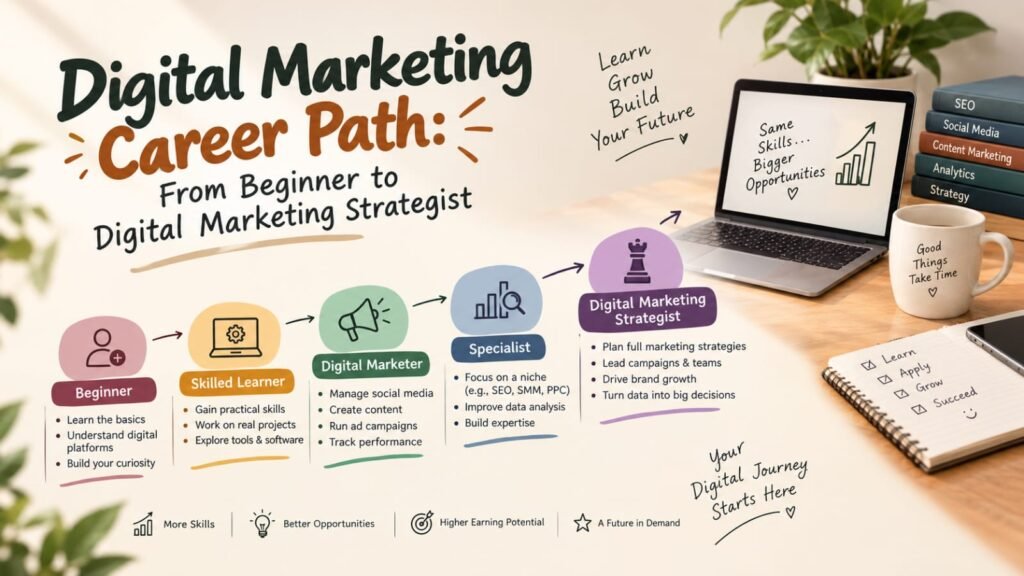
This guide explains a practical digital marketing career path—from the beginner stage to a more strategic role.
Quick Answer: What Is the Digital Marketing Career Path?
A simple digital marketing career path can look like this:
Learn the Basics → Build Core Skills → Practice → Choose a Specialization → Build a Portfolio → Gain Experience → Understand Analytics → Develop Strategic Thinking → Become a Digital Marketing Strategist
You do not need to master every area before starting your first role.
The goal is to gradually move from executing individual marketing tasks to understanding how different marketing activities work together to achieve business goals.
What Is a Digital Marketing Career?
A digital marketing career involves using digital channels, platforms, content, advertising, data, and marketing strategies to help businesses reach and engage their target audiences.
Depending on the role, a digital marketer may work on:
- Social media
- SEO
- Content marketing
- Paid advertising
- Email marketing
- Website optimization
- Analytics
- Lead generation
- Brand awareness
- Conversion optimization
Digital marketing is a broad field, which means there are different career paths within it.
Some professionals specialize in one area, while others develop broader skills and eventually move toward strategy and management.
Stage 1: Start With the Digital Marketing Fundamentals
Every digital marketing career starts with understanding the basics.
Before focusing on advanced tools, learn how digital marketing works as a complete system.
Important concepts include:
Target Audience
Understand who a business wants to reach and what those people need, want, or struggle with.
Customer Journey
Learn how people move from discovering a brand to considering, purchasing, and eventually returning to it.
Marketing Funnel
Understand stages such as:
Awareness → Consideration → Conversion → Retention
Branding
Learn how businesses communicate their identity, value, personality, and positioning online.
Digital Channels
Understand the purpose of channels such as:
- Search engines
- Social media
- Websites
- Online advertising
- Video platforms
A strong foundation makes it easier to understand more specialized areas later.
Stage 2: Build Your Core Digital Marketing Skills
Once you understand the fundamentals, start developing practical skills.
SEO
Search Engine Optimization helps businesses improve their visibility in search engines.
Learn about:
- Keyword research
- On-page SEO
- Technical SEO basics
- Internal linking
- Search intent
- Content optimization
- SEO performance
Social Media Marketing
Learn how brands use platforms to build awareness and relationships with audiences.
Skills include:
- Content planning
- Social media strategy
- Copywriting
- Community engagement
- Content calendars
- Performance analysis
Content Marketing
Content marketing focuses on creating useful and relevant information for a target audience.
Learn:
- Blog writing
- Content strategy
- Storytelling
- Content planning
- Content repurposing
- Audience-focused writing
Paid Advertising
Paid advertising introduces you to performance-based marketing.
Begin with concepts such as:
- Campaign objectives
- Audience targeting
- Ad creatives
- Budgeting
- Campaign measurement
- Conversion tracking
Platforms may include Meta Ads, Google Ads, LinkedIn Ads, and other advertising systems depending on your goals.
Email Marketing
Email marketing helps businesses communicate directly with their audience.
Learn about:
- Email campaigns
- Newsletters
- Audience segmentation
- Subject lines
- Calls to action
- Performance metrics
Stage 3: Learn the Tools
Learning concepts is important, but digital marketing is also a practical field.
Start becoming comfortable with commonly used tools.
Area | Example Tools |
SEO | Google Search Console, Google Trends |
Analytics | Google Analytics |
Social Media | Meta Business Suite |
Design | Canva |
Email Marketing | Mailchimp, HubSpot |
Keyword Research | Google Keyword Planner |
Website | WordPress, Elementor |
Content | Canva, AI-assisted tools |
You don’t need to master every tool at once.
Learn a tool when you have a practical reason to use it.
For example, if you are creating a website, learn Elementor. If you are managing social media campaigns, explore Meta Business Suite.
Stage 4: Practice What You Learn
This is where your learning becomes practical experience.
Instead of only watching tutorials or completing courses, create your own projects.
You could:
- Create a sample Instagram strategy
- Build a simple website
- Write SEO-friendly blog posts
- Create a content calendar
- Run a small practice campaign
- Analyze a brand’s social media presence
- Create an email campaign
- Perform basic keyword research
- Develop a digital marketing plan
For beginners, personal projects can become valuable portfolio pieces.
Example
Imagine you create a fictional jewellery brand.
You could develop:
Brand → Website → Instagram strategy → Content calendar → SEO blog → Meta Ad concept → Email campaign → Analytics plan
One project can demonstrate several digital marketing skills.
Stage 5: Build a Digital Marketing Portfolio
A portfolio shows what you can actually do.
Instead of simply writing:
“I know social media marketing.”
Show examples of your work.
Your portfolio could include:
Social Media Project
Show your content strategy, sample posts, captions, and content calendar.
SEO Project
Show keyword research, content optimization, and an example blog.
Paid Advertising Project
Show campaign objectives, audience research, creative concepts, and performance metrics where available.
Content Marketing Project
Show blog posts, content plans, or content campaigns.
Website Project
Show website structure, landing pages, basic SEO, and user-focused design.
For a beginner, well-presented practice projects can demonstrate initiative and practical understanding.
Stage 6: Choose a Specialization
Once you have explored different areas, you may discover what interests you most.
Possible specializations include:
- SEO Specialist
- Social Media Specialist
- Content Marketer
- Paid Media Specialist
- Email Marketing Specialist
- Performance Marketer
- Digital Marketing Executive
- Digital Marketing Analyst
Specialization allows you to develop deeper knowledge in a particular area.
However, understanding the broader digital marketing ecosystem remains valuable because different channels often work together.
Stage 7: Gain Real-World Experience
The next step is applying your skills in real situations.
Experience can come through:
- Internships
- Freelance projects
- Personal projects
- Volunteer work
- Agency experience
- Small business projects
- Entry-level marketing roles
Real projects teach you things that tutorials cannot fully demonstrate.
You learn how to:
- Work with deadlines
- Communicate with clients or teams
- Handle feedback
- Adapt content
- Analyze performance
- Solve unexpected problems
- Connect marketing activities with business objectives
Stage 8: Learn Analytics and Measurement
As you progress, you need to move beyond simply creating content or launching campaigns.
You need to understand:
“What happened, and why?”
Important metrics can include:
- Website traffic
- Engagement
- Click-through rate
- Conversion rate
- Leads
- Cost per result
- Return on ad spend
- Search performance
- Email performance
The exact metrics depend on the campaign objective.
For example, an awareness campaign and a lead-generation campaign should not necessarily be measured in the same way.
Analytics helps you identify what is working, what needs improvement, and where marketing resources may be better focused.
Stage 9: Develop Strategic Thinking
This is where the role starts moving from Digital Marketer toward Digital Marketing Strategist.
A strategist does more than ask:
“What should we post?”
They also ask:
“Why are we posting it, who is it for, what business objective does it support, and how will we measure the result?”
Strategic thinking involves connecting:
Business Goal → Audience → Positioning → Channel → Content → Campaign → Conversion → Measurement
For example, if a business wants more leads, a strategist might consider:
- Who is the ideal customer?
- What problem does the business solve?
- Which digital channels can reach that audience?
- What content can attract them?
- What offer can encourage action?
- Where should visitors be directed?
- How will conversions be tracked?
- Which parts should be optimized?
This broader thinking is a key part of strategic digital marketing.
Beginner vs Digital Marketing Strategist
Beginner Digital Marketer | Digital Marketing Strategist |
Learns marketing fundamentals | Connects marketing with business goals |
Creates individual content | Develops content strategy |
Uses marketing tools | Selects tools and channels strategically |
Follows campaign plans | Helps develop campaign direction |
Tracks basic metrics | Interprets data for decisions |
Focuses on tasks | Focuses on objectives and outcomes |
Learns individual channels | Understands how channels work together |
Builds practical skills | Makes strategic recommendations |
The progression is not always linear. Different professionals develop at different speeds and may specialize before moving into broader strategic roles.
What Skills Does a Digital Marketing Strategist Need?
A strategist needs a combination of marketing knowledge, analytical thinking, communication, creativity, and business understanding.
Strategic Planning
Ability to create marketing plans based on business objectives.
Audience Research
Ability to understand customer needs, behavior, interests, and search intent.
Data Analysis
Ability to interpret marketing performance and identify opportunities for improvement.
Content Strategy
Ability to determine what content should be created, for whom, and why.
Channel Knowledge
Understanding how SEO, social media, paid ads, email, websites, and content can work together.
Communication
Ability to explain strategies and recommendations clearly to clients or teams.
Problem Solving
Marketing rarely goes exactly according to plan. Strategists need to identify problems and develop practical solutions.
Common Mistakes Beginners Should Avoid
Trying to Learn Everything at Once
Digital marketing is huge. Focus on building a strong foundation before attempting to master every tool.
Only Learning Theory
Knowledge becomes more valuable when you practice it.
Ignoring Analytics
Creating content without reviewing performance makes improvement difficult.
Copying Other Brands
Study successful examples, but develop your own understanding and approach.
Chasing Every Trend
Not every trend is relevant to every brand. Strategy should come before trends.
Focusing Only on Vanity Metrics
Likes and views can be useful indicators, but they do not always represent the main business outcome.
Stopping After Completing a Course
Courses provide a foundation. Practical projects, experience, and continuous learning are important for long-term development.
A Simple Digital Marketing Career Roadmap
You can remember the journey like this:
LEARN
Understand digital marketing fundamentals.
↓
PRACTICE
Work on personal and sample projects.
↓
BUILD
Create a portfolio and demonstrate your skills.
↓
SPECIALIZE
Develop deeper expertise in selected areas.
↓
EXPERIENCE
Work on real projects and gain practical exposure.
↓
ANALYZE
Learn to interpret data and performance.
↓
STRATEGIZE
Connect marketing channels with business objectives.
↓
GROW
Continue learning and develop strategic leadership skills.
How SEO, AEO and GEO Fit Into a Modern Digital Marketing Career
The digital marketing landscape continues to evolve.
SEO
SEO focuses on helping relevant content become discoverable through search engines.
AEO
Answer Engine Optimization focuses on providing clear, direct answers to questions so information can work well in answer-oriented search experiences.
GEO
Generative Engine Optimization is commonly discussed in the context of making content clear, structured, useful, and easier for generative AI systems to understand and potentially reference.
For a modern digital marketer, the important foundation remains the same:
Understand the audience → Create useful content → Make information clear → Build credibility → Measure performance → Improve continuously.
Frequently Asked Questions
Yes. Beginners can start by learning the fundamentals, practicing through personal projects, building a portfolio, and looking for internships or entry-level opportunities.
A marketing-related degree can be useful, but digital marketing also involves practical skills that can be developed through courses, projects, experience, and continuous learning.
There is no fixed timeline. The basics can be learned relatively quickly, but developing professional-level skills requires continued practice and real-world experience.
Start with the fundamentals of digital marketing, audience research, content, SEO, social media, analytics, and basic paid advertising. You can then identify the areas you want to specialize in.
A Digital Marketing Strategist develops and guides digital marketing plans based on business objectives, target audiences, channels, content, campaigns, and performance data.
Conclusion
A digital marketing career is not about learning one tool or mastering one platform.
It is a continuous journey from understanding marketing fundamentals to applying practical skills, gaining experience, analyzing results, and eventually thinking strategically.
Start small.
Learn the fundamentals.
Practice consistently.
Build real projects.
Create a strong portfolio.
Gain practical experience.
Develop analytical skills.
Understand how different channels work together.
Then move toward strategic thinking.
The transition from beginner to Digital Marketing Strategist happens when you stop looking at marketing as a collection of individual tasks and start seeing it as a connected system designed to achieve meaningful business goals.
“A digital marketer executes the strategy. A strategist understands why the strategy works.”
Ready to build your digital marketing career? Start with one skill, practice it consistently, and let every project become a step toward your next level.