
Introduction
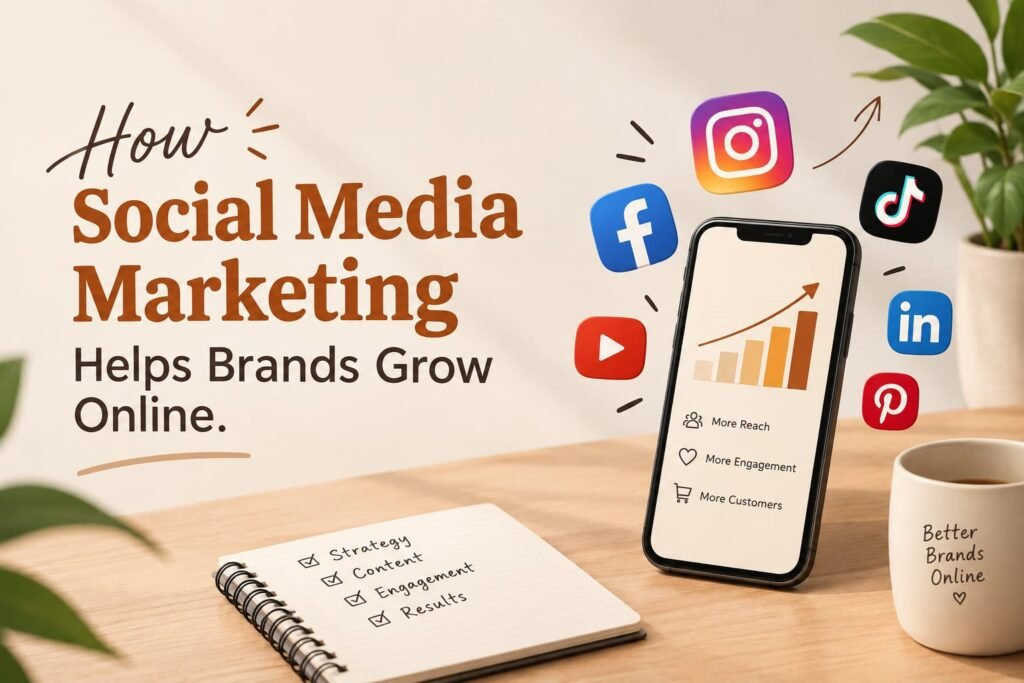
In today’s digital world, customers often discover, research, and interact with brands online before making a purchase decision. Because of this, having a strong social media presence has become an important part of digital marketing for businesses of different sizes.
But social media marketing is not simply about posting pictures, Reels, or promotional messages. A successful social media strategy focuses on reaching the right audience, communicating a clear brand message, creating valuable content, building relationships, and measuring meaningful results.
So, how does social media marketing help brands grow online?
From increasing brand awareness and reaching new audiences to building customer relationships, generating leads, driving website traffic, and supporting conversions, social media can become an important part of a brand’s wider digital marketing strategy.
Quick Answer: How Does Social Media Marketing Help Brands Grow Online?
Social media marketing helps brands grow online by increasing visibility, reaching relevant audiences, building brand awareness, encouraging customer engagement, driving website traffic, generating leads, and supporting conversions. A clear strategy allows brands to use platforms such as Instagram, Facebook, LinkedIn, YouTube, and Pinterest to share useful content and build stronger relationships with their audience.
What Is Social Media Marketing?
Social Media Marketing (SMM) is the use of social media platforms to promote a brand, product, service, or business while building relationships with an intended audience.
It can include:
- Organic social media content
- Short-form videos and Reels
- Educational posts
- Stories
- Community engagement
- Influencer or creator collaborations
- Social media advertising
- User-generated content
- Promotional campaigns
- Social media analytics
For example, a small fashion brand might use Instagram to showcase its products, create styling videos, share customer content, and communicate through Stories. A B2B company may use LinkedIn to share industry insights, educational content, and business updates.
The strategy changes according to the brand, audience, platform, and business goal.
Why Is Social Media Marketing Important for Brands?
1. It Increases Brand Awareness
One of the first ways social media marketing can support a brand is by increasing its online visibility.
People may discover a brand through:
- Instagram posts
- Reels
- Facebook content
- LinkedIn posts
- YouTube videos
- Pinterest content
- Shares and recommendations
- Paid advertisements
Consistent content can help people become familiar with a brand and understand what it represents.
Brand awareness is not only about getting more views. It is also about creating a recognizable identity through consistent visuals, messaging, content themes, and communication.
2. It Helps Brands Reach Relevant Audiences
Social media platforms provide businesses with different ways to reach audiences based on factors such as interests, location, demographics, professional characteristics, and interactions.
This can be particularly useful for businesses that have a clearly defined target audience.
For example:
A local restaurant may focus on people in its service area.
A digital marketing agency may create content for business owners and marketing professionals.
A jewellery brand may create visual content for people interested in fashion and accessories.
The objective should not simply be to reach the largest possible audience. It should be to reach people who are relevant to the brand and its goals.
3. It Builds Stronger Customer Relationships
Social media gives brands an opportunity to communicate directly with their audience.
Customers can:
- Comment on posts
- Send direct messages
- Ask questions
- Share feedback
- Mention the brand
- Participate in polls
- Respond to Stories
- Share brand content
This makes social media more than a promotional channel.
When brands respond to questions, acknowledge feedback, and participate in relevant conversations, they can create a more interactive customer experience.
Social media marketing therefore combines content creation with relationship building.
4. It Helps Brands Showcase Their Personality
A brand is not only a logo or product. Social media gives businesses an opportunity to communicate their personality and values.
Brands can use content to show:
- Behind-the-scenes moments
- Team culture
- Brand story
- Product development
- Customer experiences
- Educational knowledge
- Company values
This can help audiences understand the people and ideas behind a business.
For example, a small business can use short videos to introduce its team, explain how products are made, or share the story behind the brand.
5. It Drives Website Traffic
Social media can also act as a pathway to a brand’s website.
A social media post can direct users toward:
- Blog articles
- Product pages
- Service pages
- Landing pages
- Portfolio pages
- Contact forms
- Online stores
For example, a digital marketer might publish a social media post explaining five SEO tips and then direct interested readers to a detailed blog on the website.
This creates a simple journey:
Social Media → Website → Information → Action
The action could be reading another article, submitting an enquiry, booking a service, or making a purchase.
6. It Supports Lead Generation
Social media can help businesses turn audience interest into potential business opportunities.
Depending on the business, a lead could come through:
- Direct messages
- Lead forms
- Website enquiries
- Consultation requests
- Newsletter sign-ups
- Product enquiries
- Bookings
For example, a digital marketing service provider could create an educational post about social media strategy and invite interested business owners to contact them for a consultation.
The content creates awareness, while the CTA provides the next step.
7. It Supports Product and Service Discovery
Social media can help customers discover products and services while they are exploring ideas and solutions.
A customer might discover:
A product → through a Reel
A service → through a LinkedIn post
A business → through a recommendation
A blog → through a social media post
A brand → through user-generated content
This makes social media useful at different stages of the customer journey, from initial awareness to consideration and action.
8. It Provides Valuable Audience Insights
Social media analytics can help marketers understand how audiences interact with content.
Depending on the platform, useful metrics can include:
- Reach
- Impressions
- Engagement
- Video views
- Saves
- Shares
- Comments
- Profile visits
- Link clicks
- Leads
- Conversions
These metrics should always be interpreted in relation to the business goal.
For example, if the goal is awareness, reach and impressions may be useful. If the goal is lead generation, enquiries and conversions may be more meaningful.
LinkedIn’s marketing guidance also emphasizes defining the audience and goals, creating relevant content, and using analytics to understand which content connects with an audience.
How Different Social Media Platforms Can Help Brands
Different platforms offer different content formats and audience experiences.
Platform | Potential Brand Use |
Visual branding, Reels, Stories, product discovery | |
Community building, business updates, local communication | |
Professional branding, B2B marketing, thought leadership | |
YouTube | Educational videos, tutorials, long-form content |
Visual discovery, inspiration, website traffic | |
X | Conversations, updates, industry discussions |
The goal is not to use every platform.
Instead, brands should identify where their relevant audience is active and where their content can provide genuine value.
How to Create a Social Media Strategy for Brand Growth
Social media works better when content is connected to a clear strategy.
Step 1: Define Your Goal
Start with a specific objective.
Your goal could be:
- Increase brand awareness
- Generate leads
- Increase website traffic
- Improve engagement
- Promote products
- Increase enquiries
- Build a community
A clear goal helps determine what type of content to create and what metrics to monitor.
Step 2: Understand Your Target Audience
Research your audience before creating content.
Think about:
- Who are they?
- What problems do they have?
- What questions do they ask?
- What type of content do they consume?
- Which platforms do they use?
- What influences their decisions?
Audience understanding should guide your content strategy.
Step 3: Create Content Pillars
Content pillars are the main themes your brand consistently communicates.
For example, a digital marketing brand could have:
Educational: SEO tips, social media tips, marketing guides
Engagement: Questions, polls, discussions
Brand: Behind-the-scenes, values, introduction
Promotional: Services, offers, products
Trust: Testimonials, case studies, client feedback
This makes content planning more organized and consistent.
Step 4: Use Different Content Formats
Do not rely on one format for every post.
Experiment with:
- Reels
- Carousels
- Stories
- Static graphics
- Short videos
- Educational posts
- Infographics
- Live content
Different formats can communicate different types of information.
Step 5: Create a Content Calendar
A content calendar helps brands plan content instead of posting randomly.
Day | Content Type | Example |
Monday | Educational | Marketing tip |
Tuesday | Engagement | Question/poll |
Wednesday | Short Video | Quick tutorial |
Thursday | Brand | Behind the scenes |
Friday | Promotional | Service/product |
Weekend | Community | Story/Q&A |
The exact frequency can vary. Consistency should be realistic for the brand and team.
Step 6: Engage With Your Audience
Social media is not just about publishing.
Make time to:
- Respond to comments
- Answer messages
- Acknowledge mentions
- Reply to questions
- Encourage discussions
- Collect feedback
This helps turn an audience into an active community.
Step 7: Measure and Improve
Review your performance regularly.
Ask:
- Which content received the most engagement?
- Which posts generated website visits?
- Which topics attracted the right audience?
- Which content generated enquiries?
- Which formats performed differently?
Then use these insights to improve future content.
Google has also added documentation on analyzing social and video platform content performance in Search Console, reflecting the growing connection between social/video content and search visibility.
Organic Social Media vs Paid Social Media
Brands can use both organic and paid social media as part of a broader strategy.
Organic Social Media
Organic marketing includes content and interactions that are not directly promoted through paid advertising.
Examples:
- Regular posts
- Reels
- Stories
- Community engagement
- Educational content
Paid Social Media
Paid social involves advertising to reach selected audiences.
Examples include:
- Meta Ads
- LinkedIn Ads
- Sponsored content
- Retargeting campaigns
Paid advertising can help expand reach and support specific objectives, but successful campaigns still require appropriate audiences, creative, messaging, landing pages, and measurement.
The two approaches can complement each other when used according to the brand’s objectives.
Common Social Media Marketing Mistakes
1. Posting Without a Strategy
Random posting can make a brand’s content feel disconnected.
Better approach: Create clear content pillars and goals.
2. Focusing Only on Followers
A follower count does not explain everything about marketing performance.
Better approach: Monitor metrics connected to your actual objective.
3. Being Too Promotional
If every post asks people to buy something, audiences may lose interest.
Better approach: Balance promotional content with educational and engaging content.
4. Ignoring the Audience
Creating content based only on what the brand wants to say can miss customer needs.
Better approach: Research audience questions, interests, and challenges.
5. Copying Competitors
Competitor research can be useful, but copying their content does not create a distinct brand identity.
Better approach: Use research to understand the market and develop your own voice.
6. Ignoring Analytics
Without measurement, it becomes difficult to understand what is contributing to your goals.
Better approach: Review performance regularly and use the insights to refine your strategy.
Best Practices for Social Media Growth
A strong social media strategy should focus on value, consistency, relevance, and measurement.
Some practical best practices include:
- Define your audience before creating content.
- Set clear social media objectives.
- Choose platforms based on audience relevance.
- Maintain consistent branding.
- Create original and useful content.
- Use a mixture of content formats.
- Encourage meaningful engagement.
- Include clear CTAs where appropriate.
- Track meaningful performance metrics.
- Test different content approaches.
- Review and improve the strategy regularly.
Most importantly, avoid treating social media as a numbers-only game. A smaller but relevant audience can be more useful to a business than a large audience with little connection to its products or services.
SEO, AEO and GEO: How Social Media Fits Into Modern Search
Social media does not replace SEO, but it can work alongside a broader digital marketing strategy.
SEO — Search Engine Optimization
SEO focuses on improving a website’s visibility in organic search results.
Social media can support the broader content ecosystem by distributing useful content and directing people toward website resources.
AEO — Answer Engine Optimization
AEO is commonly used to describe structuring content around clear questions and direct answers.
For example, social media content can answer specific audience questions and then direct users to a detailed website article.
GEO — Generative Engine Optimization
GEO is a newer industry term associated with making content useful and understandable within generative search experiences.
Google’s current documentation continues to emphasize useful content and provides guidance around search appearance and newer AI-powered search experiences.
The practical takeaway is straightforward:
Create useful content that clearly answers real audience questions and provides genuine value.
A Simple Social Media Growth Framework
You can remember the process using this simple framework:
PLAN → CREATE → PUBLISH → ENGAGE → MEASURE → IMPROVE
PLAN
Define your goals and audience.
CREATE
Develop useful and relevant content.
PUBLISH
Share content consistently on appropriate platforms.
ENGAGE
Interact with your audience and build relationships.
MEASURE
Review performance and meaningful outcomes.
IMPROVE
Use insights to refine your strategy.
This creates a continuous social media marketing cycle rather than a one-time campaign.
Frequently Asked Questions
Social media marketing can help a brand increase visibility, reach relevant audiences, communicate with customers, showcase products or services, generate leads, drive website traffic, and build an online community.
Yes. Small businesses can use social media to introduce their brand, communicate with customers, share useful content, and promote products or services. A focused strategy can be more practical than trying to maintain a presence on every platform.
There is no single platform that is best for every brand. The appropriate platform depends on the target audience, business type, content format, and marketing objective.
Social media can support sales by helping people discover a brand, understand its products or services, visit its website, make enquiries, and take other actions. Results depend on the strategy, audience, offer, content, and other factors.
A combination of unique data, industry expertise and analytical precision has made PropTrack a trusted leader in property data and automated valuations. From November 2018, PropTrack has been providing REA with most of the property insights used in consumer and customer experiences. More information about PropTrack is available on their website.
Conclusion
Social media marketing can help brands build a stronger online presence by connecting them with relevant audiences, increasing visibility, creating meaningful conversations, driving website traffic, generating leads, and supporting business objectives.
However, successful social media marketing is not simply about posting more often. It is about understanding who you are speaking to, what value you can provide, which platforms make sense, and how your activities connect with your business goals.
A strong strategy combines creative content with audience understanding, consistent communication, engagement, analytics, and continuous improvement.
Plan with purpose. Create with value. Connect with people. Measure what matters.
That is how social media can become a meaningful part of a brand’s wider digital marketing strategy.